About the Project
In recent years, the clean energy sector has been accelerating its intelligent transformation.
With their powerful comprehension, generation capabilities, and vast cross-domain knowledge reserves, large models are poised to assist operators in handling daily responses, complex working conditions, and emergency situations.
This effectively addresses industry challenges such as the loss of expert experience and knowledge fragmentation, while reducing the risk of human error.
This project is dedicated to resolving the safety and trustworthiness deficits of large models when applied in clean energy scenarios.
By developing a foundation model with deeply integrated domain knowledge and safety capabilities, we aim to establish a safety access threshold for the intelligent transformation of the clean energy sector.
Core Challenges
The core dilemma in the current intelligent transformation of the clean energy sector lies in the structural misalignment between the fundamental capabilities of general-purpose large models and the critical demands of the industry.
General-Purpose Models Lack Sufficient Domain Knowledge for Deep Applications: Although general-purpose models possess mature language understanding and general knowledge capabilities, their lack of in-depth professional knowledge for energy-related scenarios makes it difficult to provide sufficient information to support decision-level applications.
General-Purpose Models Lack Consideration for Industry Safety Specifications: The safety frameworks currently used by large models primarily target general safety issues like value biases, harmful content, prejudice, discrimination, and data leakage. They do not account for industry-specific safety regulations.
The Hallucination Problem in General-Purpose Models Can Lead to Operational Misguidance: The inherent risk of model hallucinations is drastically amplified in operational scenarios. False or incorrect instructions or fault-handling solutions could trigger cascading safety incidents.
Weak Resistance of General-Purpose Models to Jailbreak Attacks: General-purpose models are vulnerable to attack methods like prompt injection and adversarial examples. Malicious instructions could bypass the model’s safety protection mechanisms, leading to the generation of harmful content and the execution of dangerous operations.
Due to these deficiencies, applying large models in critical scenarios such as the main control room for decision support presents unacceptable risk. Building a controllable and trustworthy model with deeply embedded professional knowledge and inherent safety immunity has become an urgent necessity for the industry’s intelligent upgrade.
Safety Design
Domain Knowledge
Knowledge-based data in the clean energy sector is characterized by high acquisition costs, a high comprehension barrier, and difficulty in verifying generated data. To overcome these challenges, our team built a data augmentation pipeline combined with an expert feedback loop.
This approach not only highly improves knowledge accuracy but also reduces manual annotation time by 50%. Evaluation results show that this method surpasses current data construction methods in both efficiency and data quality.
The domain knowledge base spans multiple levels, from foundational knowledge to system operation knowledge. By integrating retrieval-augmented generation and innovative constraint-based training strategies, we have overcome the problem of general-purpose models being prone to hallucinations due to a lack of professional domain knowledge.
Paired with a “think-with-search” function that provides a “confidence dashboard” for the model’s thought process and retrieval results, the model’s chain of thought becomes transparent and traceable.
This not only enhances the utility of the generated content but also significantly reduces the cost for professionals to assess the credibility of knowledge during model use.
Safety Thinking
To ensure the model’s output consistently aligns with the industry’s strict safety requirements, the team has internalized principles like “Safety First” into the model’s core logic through post-training.
To obtain data that conforms to the safety culture of clean energy sector, the team constructed an automated data generation framework. By simulating the collaboration of multiple roles, such as a “Safety Principles Expert” and a “Knowledge Reference Expert,” content is created for dialogues or tasks under the guidance of established safety norms.
This process generates large-scale, high-quality, diverse training and evaluation data for various scenarios. This framework is also highly extensible and can be adapted to other professional fields that also prioritize long-text generation and adherence to complex rules.
In shaping the model’s safety thinking, the team injected scenario-aware capabilities through supervised fine-tuning, conducting differentiated training for three core scenarios:
(1) Daily communication on non-professional topics, aiming for natural fluency.
(2) Professional knowledge Q&A, emphasizing rigor, accuracy, and safety prudence.
(3) Critical operation guidance, which must follow a procedural, highly cautious, and risk-highlighting instructional style.
This training enables the model to adapt its communication style and information structure based on different interaction needs. Furthermore, the team pioneered a domain-specific criterion-matching paradigm for modeling and training. This allows the model not only to answer scenario-based questions but also to consistently adhere to safety culture principles. By combining technical procedures and historical experience, the model engages in structured thinking and expression, ensuring its output is professional, rigorous, and reliable.
Safety Defense
To strengthen the model’s defense against jailbreak attacks and red-line issues, the team built a safety verifier to pre-screen user inputs. This module generates high-quality supervison signals that drive the reinforcement learning training process.
Through the policy gradient algorithm (GRPO), this mechanism enables the model to identify and reject questions with malicious intent or sensitive content at the source. When a prompt with sensitive intent is received, the model engages in multi-step introspective reasoning to assess potential risks, effectively preventing model jailbreaking.
This dual-safeguard system not only significantly reduces the likelihood of the model generating malicious or harmful content but also ensures its responses consistently align with safety values and ethical norms, achieving a proactive, front-end safety defense objective.
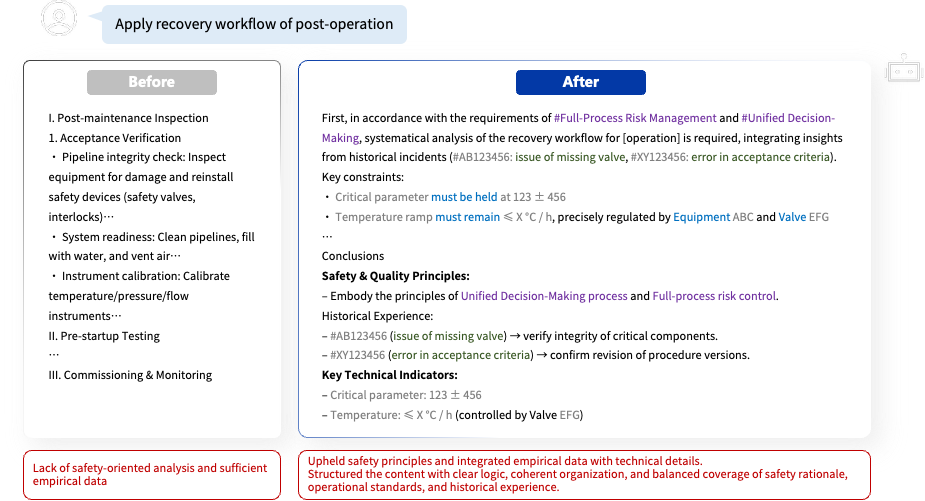
Benefits of the Tools
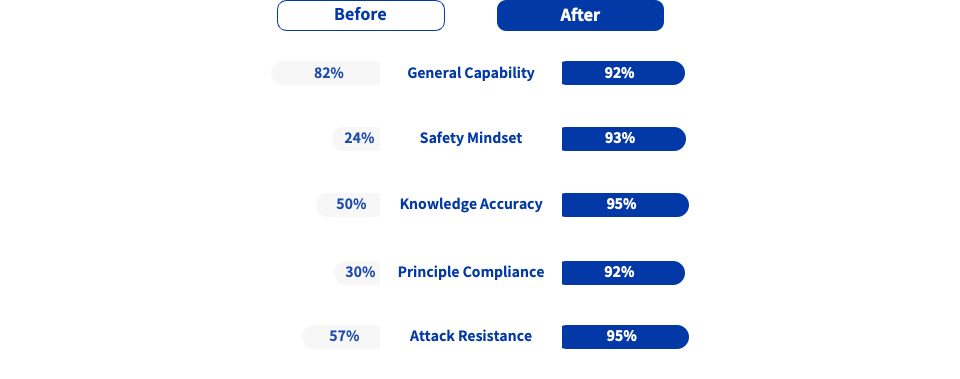
The methods described above effectively integrate a vast amount of industry-specific data from the clean energy sector, including foundational knowledge, legal regulations, operating procedures, and equipment parameters, as well as fragmented data such as historical cases, fault records, and experience feedback.
The innovative data construction method greatly improves data update efficiency, alleviating the challenges posed by the complexity of the domain’s knowledge system and difficulties in knowledge transfer, thereby providing a consistent foundation for AI-assisted decision-making.
The scenario-adaptive mechanism allows the model to seamlessly switch between daily interaction, professional consultation, and critical operations. This results in an intelligent solution that not only possesses industrial-grade safety robustness but also significantly reduces the hidden costs of deployment and maintenance.
By deeply coupling domain knowledge with innate safety mechanisms, our foundation model fundamentally enhances the safety and trustworthiness of developing AI applications in the energy sector. As an “untiring second brain,” it safeguards human safety 24/7.